There are some conversations that feel bigger than an event.
This is one of them.
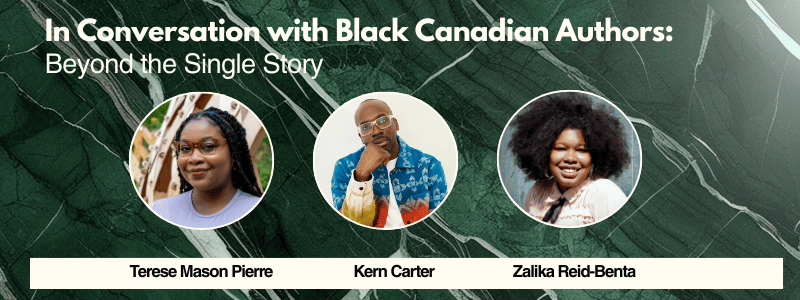
On Sunday, March 1, 2026 (2:00–4:00 PM), Pickering Public Library is hosting In Conversation with Black Canadian Authors: Beyond the Single Story at the Central Library Auditorium, and I have the joy of moderating it. The panel features Kern Carter, Terese Mason Pierre, and Zalika Reid-Benta, and the afternoon will include readings, a moderated conversation, and audience Q&A. Registration is required.
But this is more than a date on a calendar.
This conversation is about what happens when we refuse to let Black Canadian stories be flattened.
Black Canadian stories were never meant to be one thing
A lot of people still approach Black storytelling like it should be easy to summarize.
As if one book can stand in for all of us.
As if one kind of pain, one kind of joy, one kind of family, one kind of voice is enough.
It’s not.
Black Canadian storytelling is layered. It’s regional. It’s diasporic. It’s tender and sharp. It carries migration, memory, language, longing, survival, humour, and imagination, sometimes all in the same paragraph.
And that’s exactly why this event matters.
The library’s event description says it plainly: Black Canadian stories can’t be contained in a single narrative, and they were never meant to be. It also frames this panel as a celebration of Black Canadian literature’s “range, rhythm, truth-telling, and imagination,” which is such a beautiful and necessary way to name the work.
What “beyond the single story” means in real life
For me, “beyond the single story” is not just a literary idea. It’s a reading practice.
It means reading Black Canadian writers in a way that honours complexity.
It means asking:
- What is this story refusing to simplify?
- What kind of Canada is this book showing me?
- What does belonging look like here?
- What is remembered, and what is protected?
- What is imagined that does not yet exist?
Because Black Canadian stories are not just about identity in a broad, surface-level sense. They are often about place and distance. About home and homesickness. About lineage and becoming. About the tension between how a country sees us and how we know ourselves.
And they are also about ordinary life. Friendship. Family. Desire. Faith. Grief. Mess. Laughter. The quiet things. The things people miss when they only read for “issues.”
That’s what I want this panel to hold.
The kind of conversation we need more of
One thing I love about this event is that it is intentionally book-centred.
The afternoon opens with brief readings, then moves into a moderated discussion on voice, craft, place, and the questions these books are asking, about belonging, memory, love, lineage, and what it means to tell Black stories in Canada “with complexity and care.” It closes with an audience Q&A.
That wording matters to me: complexity and care.
Because when we talk about Black books, we deserve more than hot takes.
We deserve depth.
We deserve context.
We deserve to sit with language and choices and what a story is doing under the surface.
This is the kind of literary conversation that feeds readers.
Meet the writers
This panel brings together three writers whose work moves in different directions, and that’s part of the point.
Kern Carter
Kern Carter is as a Toronto-based novelist known for emotionally sharp stories exploring family, friendship, and complicated relationships through a contemporary Black Canadian lens. The event page highlights And Then There Was Us, Boys and Girls Screaming, and Is There a Boy Like Me?
Terese Mason Pierre
Terese Mason Pierre is a writer and editor whose work moves between literary and speculative writing. The library notes that she won the 2023 Writers’ Trust of Canada McClelland & Stewart Journey Prize and is co-editor-in-chief of Augur Magazine. Featured titles include Myth and As the Earth Dreams (as editor).
Zalika Reid-Benta
Zalika Reid-Benta’s work, draws on Jamaican diasporic life and folklore, blending realism with the mythic and intimate. The featured books are Frying Plantain and River Mumma.
Three different voices. Three different bodies of work. Three different ways of telling truth.
That is the point.
If you can’t attend, here’s how to still read beyond the single story
I always want TBGR posts to offer something you can carry with you, even if you can’t make the event.
So if you’re not able to attend, here’s a simple reading practice for this week:
A TBGR Mini Reading Practice
Pick one Black Canadian book (novel, memoir, stories—anything). Read 15–20 pages and journal these prompts:
- What is this book teaching me about Black life in Canada that feels specific—not generic?
- Where do I see complexity instead of stereotype?
- What does this writer make room for (grief, joy, silence, softness, contradiction, humour)?
- What lingers after I close the book?
This is how we build a deeper reading life.
Not just by finishing books, but by learning how to listen to them, learning how to sit with them.
Why this matters to TBGR
If you’ve been here for a while, you already know: TBGR has always been about more than “book recommendations.”
It’s about building a reading life that makes us fuller.
It’s about stories as connection.
It’s about Black readers having space to think deeply, feel deeply, and read beyond what the market says is trending.
This event sits right inside that mission.
And I’m especially grateful to be moderating this conversation as someone who believes reading is not just consumption, it’s community. It’s memory work. It’s a way of returning to ourselves.
Event Details
In Conversation with Black Canadian Authors: Beyond the Single Story
Date: Sunday, March 1, 2026
Time: 2:00 PM – 4:00 PM
Location: Pickering Public Library, Central Library (Auditorium)
Ages: Adult, Young Adult, Seniors
Featured writers: Kern Carter, Terese Mason Pierre, Zalika Reid-Benta
Moderated by Lalaa Comrie (This Black Girl Reads)
If you’re in the area, come sit with us.
And if you can’t make it, let this be your reminder:
Black Canadian storytelling is not one note, one mood, or one narrative.
It is wide.
It is alive.
It is still unfolding.
And we need readers who are willing to meet it there.